
Onondaga County’s 14-Day Arrest Log
The Sheriff posts no full 72-hour, weekly, or other multi-day booking blotter. Selected releases sit in its Recent News archive. Its Police Blotter category lists no current entries. Neither page promises a fixed depth, a weekend publishing schedule, or a roster of everyone booked at the Patrick J. Corbett Justice Center.
The best person-level fallback is the Syracuse.com searchable police blotter. Unfiltered, it reports charges from the last 14 days. Searches run by name, date range, charge, or agency. Remember what it is. Syracuse.com is a news publisher, not the Sheriff, the jail, or a court.
Read the Onondaga Arrest Blotter
Check the source and date first. Then take each fact back to the agency that created it, so a news arrest row never gets confused with jail status or the eventual court result.
- Open the Syracuse.com search and leave filters blank to view its stated 14-day return window.
- Narrow by a name, date range, charge, or agency only when enough information is known to avoid a mistaken match.
- Read the filing and reporting dates carefully. A charge can be filed during the chosen period but reported later.
- Check the official Sheriff roster if the question is whether the person is held now.
- Use the originating police agency or court for the arrest report and final disposition.
Need same-day custody answers instead? The 24 Hour Arrests page explains why the current-custody roster comes first. This blotter works a different problem, reaching across several days and reporting agencies. The searchable Syracuse crime report matches that task directly.
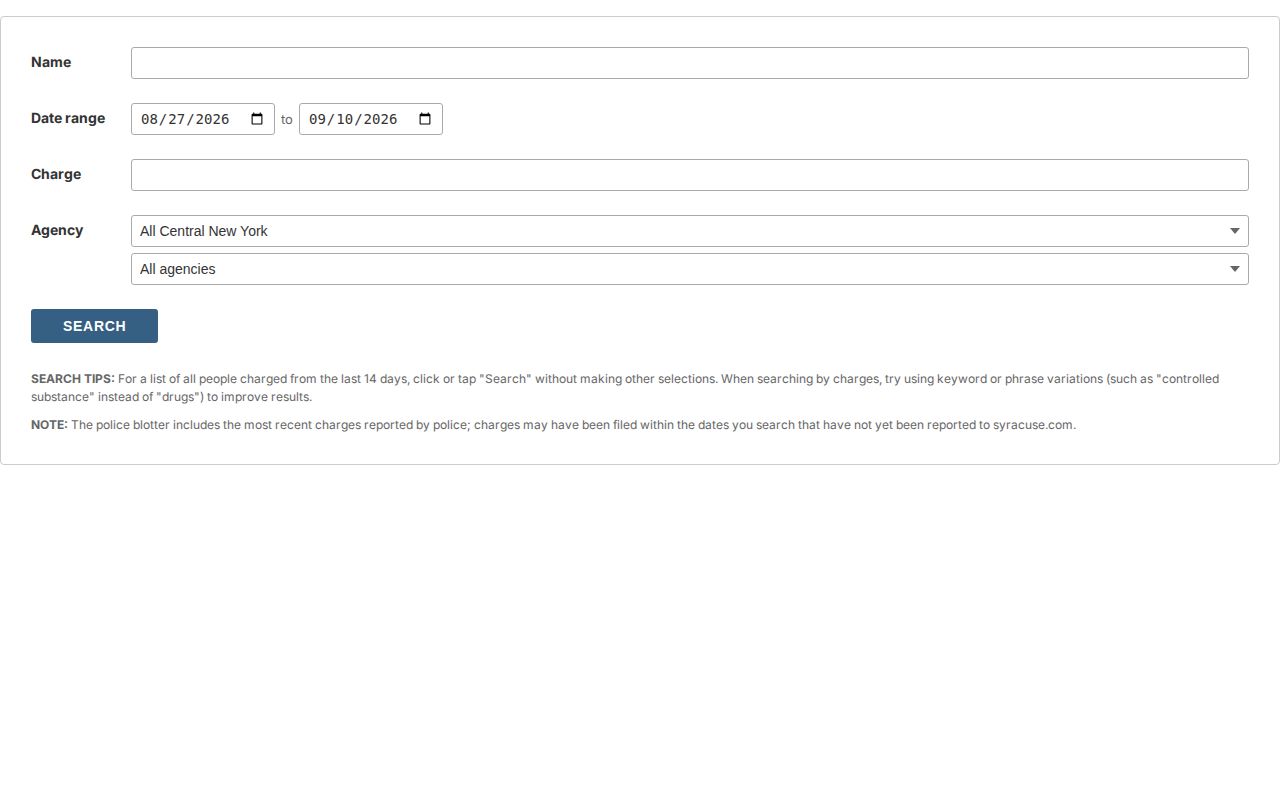
The form displays its filter set and 14-day default. No faces appear, and entries never render as a gallery.
Onondaga Arrest Log Fields
The blotter's search controls are clear. Still, the opening page promises no complete booking schema, so treat every returned detail as agency-supplied news data that needs official confirmation.
| Field or control | How to interpret it |
|---|---|
| Name | A search key, not proof that two people with similar names are the same person. |
| Date range | The selected charge period; reporting to the outlet may occur later. |
| Charge | An charge reported at that stage, not a conviction or final disposition. |
| Agency | The reported police source and the best starting point for an underlying report. |
| Photo | No routine photo field or photo requirement was documented for the blotter. |
| Custody status | Not established by the news row; use the Sheriff’s current-custody lookup. |
A Justice Center booking record runs deep. It can hold fingerprints, a photograph, intake activity, classification, property, and discharge actions. None of that should be expected in a news entry, and a missing photo proves nothing. Location labels deserve the same care. An incident location, an arresting agency, and a booking facility can be three different places. Syracuse Police may make an arrest that ends in county custody. A Sheriff case may begin in a town. The blotter's agency filter narrows the reporting source. The report itself stays with that agency. The Justice Center's role starts when someone is brought there for intake or committed by an Onondaga County court.
Onondaga Weekend Arrest Reporting
No office publishes a weekend or holiday schedule covering all Onondaga County bookings. The Sheriff's Public Information Office reviews arrest reports daily and releases selected material. That workflow is not a public roster schedule. Syracuse.com updates weekly, by its own account. Its warning also notes that filing dates and reporting dates can diverge. The official Sheriff Recent News archive shows the dated, selective releases. Those items can supplement any arrest-log search.

One source is an official narrative archive. The other is a broad, unofficial 14-day search. A Monday search can hold reports tied to earlier dates, and some incidents never get selected for coverage at all. That pattern is not a surge in arrests. News counts cannot stand in for the county's total bookings, because selection, agency delivery, and posting delay all shape what appears. After a weekend, start with the Sheriff roster for current custody. The official warning is blunt. The roster lists only people currently incarcerated, and it can include people held for another jurisdiction.
Older Onondaga Arrest Records
Past the 14-day default, try the publisher's crime archive or a specific article. That search is still news. It is not an official Onondaga booking archive. Old copy may omit later events. A dismissal, plea, or sealing might never appear.
For an agency record, contact the Sheriff Records Unit or the police department that made the arrest. Give the full name, the approximate date, the arresting agency, the facility, any case or booking number, and the exact record sought. The Sheriff follows New York's LGS-1 retention schedule. No fixed public retention period covers Justice Center booking photos.
The LGS-1 schedule sets minimum rules. It governs local government records across New York. It does not promise that every old booking image sits with the New York State Archives. If the Sheriff says a record was transferred, ask which repository holds it and the series name. For the outcome, request a certificate of disposition from the court that handled the case.
Note: A news archive preserves published coverage, the official custodian holds the arrest record, and the court decides the outcome.
Onondaga Arrest News Sources
News coverage adds color that a roster cannot. The Syracuse.com crime section pairs well with its searchable blotter. Spectrum News Central New York, LocalSYR, CNY Central, and WAER also report notable Onondaga County arrests. Reporters often include agency statements and case background. Still, none of these outlets runs a full custody list.
Clay NY News works differently. Its independent blotter pulls dispatch and State Police material for Clay, strips out names, and skips sensitive call types. That makes it useful for place-based context after arrests in that town. It cannot tell you whether anyone landed in Justice Center custody.
For arrests in Onondaga County, start official. The Sheriff roster shows current custody. The arresting agency holds its own report. The court keeps the outcome. News photos are handouts or story images, and they never prove a person is still in jail.
Arrest Log Versus Court Outcome
An arrest log records an early charge, not a final result. Booking happens at jail intake, arraignment is the first court appearance, and disposition is the judgment the court later enters. Those steps can fall on different dates in different systems, so one entry never tells the whole story.
- Booked
- Processed into the Justice Center after arrest or court commitment.
- Released
- No longer in that current-custody roster, without implying a case result.
- Disposition
- The court’s recorded outcome, which may differ from the original charge.
A charge can shrink or vanish as a case moves. A matching name alone proves little, either. Pull the court, case number, and final disposition before you conclude anything. That habit matters for any Onondaga County arrest record.
New York WebCriminal tracks selected pending criminal matters and future court dates. It warns about data lags. It also skips sealed, confidential, and finished cases. A certificate of disposition is the stronger proof of how a case ended. Trust neither a cached news row nor an unofficial status label over these sources.
The Sheriff's empty Police Blotter category sets a real local limit. It means no complete official web blotter exists. That does not mean Onondaga County had no arrests. Sheriff Recent News still posts selected dated releases. Those items may name an agency or describe an alleged crime. Their editorial picking makes them useless as a county total. Nor can they act as a booking ledger.
What if a news story and a roster result clash? Check the date of each and what each one claims. The news item may cover an old charge. The roster shows Justice Center custody right now. A quick release, a transfer, another facility, or slow reporting explains most gaps. The arresting agency and the court can close the record trail without guesswork.