
Why Clay Arrests Are County Records
Clay counted 60,527 residents in the 2020 Census. That makes it the second-largest municipal unit on the project map. Size, though, has nothing to do with who patrols the streets. The town's official service-number page sends routine law-enforcement calls to the Onondaga County Sheriff. Town notices state plainly that Clay has no police department. The Town Code marks the old department's end. It did so under Local Law No. 6-2008.
That history matters. A hunt for a Clay Police booking page goes nowhere. The Sheriff usually writes the incident report. If the person is held, the Justice Center creates the booking record. State Police can also arrest someone in Clay. They keep the police report itself. Remember that the county roster does not prove every listed person was arrested in Clay. It can also miss a Clay arrest followed by a quick release.
Note: the former town department's records history is documented in the Town Code, not in a booking file.
Where Clay Recent Arrests Appear
Clay publishes no town-run arrest log. There is no official Clay mugshot page either. The sources that exist vary widely in authority and scope, so match each one to the question it can actually answer.
| Source | Status | Best use |
|---|---|---|
| Sheriff incarceration lookup | Official, current custody | Check a last name or browse by letter for someone held at the Justice Center |
| Sheriff Recent News | Official, selective | Read releases about chosen events, not a complete feed |
| Clay NY News blotter | Unofficial, anonymous incident context | Review filtered dispatch and State Police events without using it to identify a person |
| Sheriff Records Unit | Official request channel | Seek an older booking record, report, or specific photograph |
Commercial county pages may list Clay-associated entries. They are unofficial, and entries can go stale, mismatch, or linger online after custody changes. The safer route is confirming the arresting agency, current custody, and any later court result.
Find Someone Arrested in Clay
A smart Clay lookup starts with custody. Then work back toward the event record. The Sheriff posts no official 24-hour or 48-hour booking feed, and the roster lacks any booking-date or arresting-agency filter, so a missing name deserves careful interpretation.
- Confirm the person’s full name and an approximate event date.
- Search the official county incarceration lookup by last name or alphabetic letter.
- Check whether the Sheriff or State Police handled the incident.
- For an urgent custody question, call the Justice Center Custody Department at (315) 435-1770.
- For a past record, send a narrow request to the agency that holds the report or booking file.
Someone may have been released before your search. They might be booked elsewhere, transferred, or simply not visible yet. A person can also sit at the Justice Center. That may be on another jurisdiction's behalf. The Onondaga County recent-arrests hub walks through those custody states and the county photo policy in more detail.
Clay Blotter Omits Names
The independent Clay NY News blotter has real value because it centers on this town alone. Its design, though, is not a booking list. The site checks Onondaga County 911 dispatch information plus New York State Police Troop D Zone 2 daily reports, then filters everything down to Clay. Names are generally left out. Domestic, mental-health, medical, and juvenile calls get excluded too.
Those choices mean the incident count can never stand in for arrests or Justice Center bookings. A dispatch call may end without an arrest. An omitted call may still involve real police activity. Every event still needs verification through the named agency or court. The independent Clay blotter posts its sources and exclusion language openly, without presenting a lineup of people.
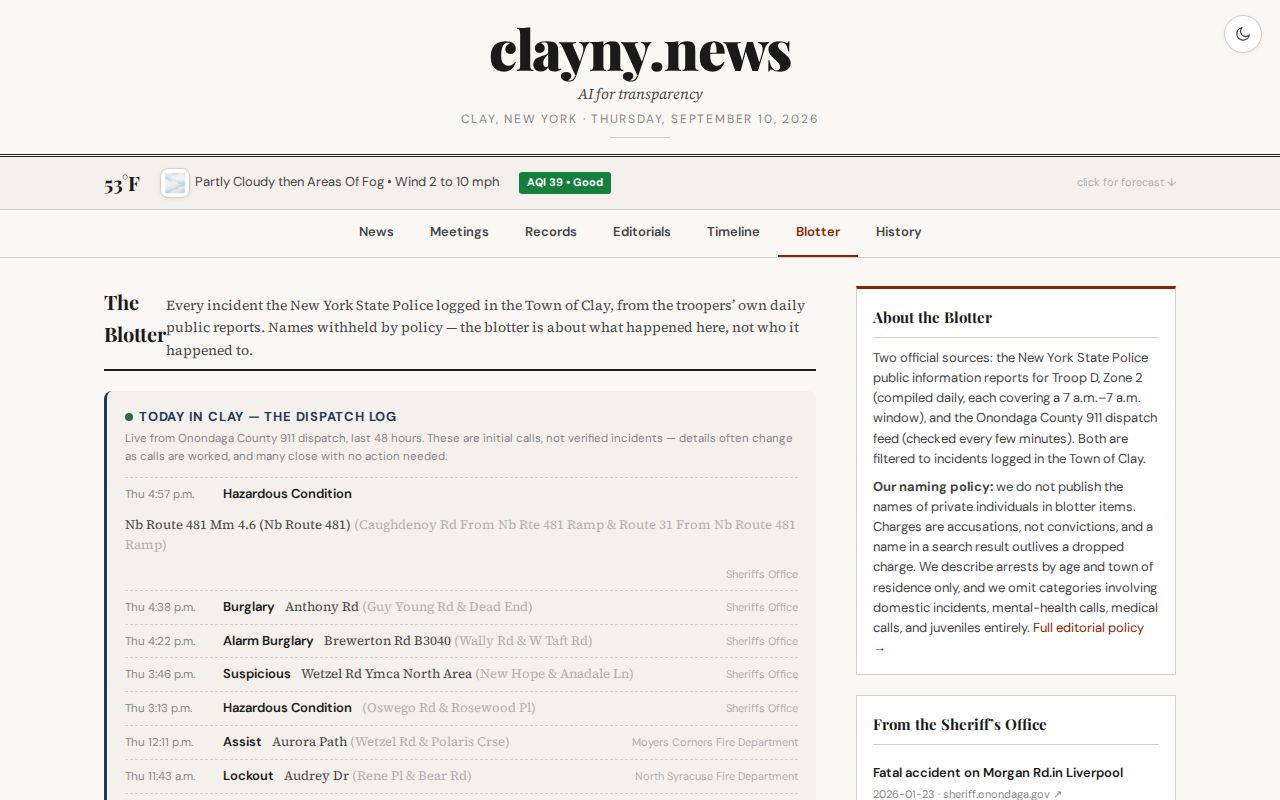
The blotter page shows town-level context only. It is not an official Clay arrest roster.
Request Clay Arrest and Booking Files
When the Sheriff made the arrest or the Justice Center processed the person, contact the Sheriff Records Unit. The number is (315) 435-3010. Name the exact item wanted. That might be an incident report, booking record, or identification photograph. Give the full name, an approximate date, and the arresting agency. Include any ICN or case number on hand. Detail lowers the odds of a search for the wrong record.
The Sheriff publishes a five-business-day FOIL response framework. That clock covers an acknowledgment or response. It is not a promise that a booking photograph arrives within five days. No fixed booking-photo fee or photo turnaround is published. Ask for an itemized cost if one applies. New York's booking-photo rule requires a case-specific privacy review. An internal image is not the same as one cleared for public display.
State Police arrests go through the State Police records process instead. When the question is outcome rather than event, identify the court. Then ask about the disposition. A Sheriff booking charge can later be amended, dismissed, resolved by plea, or tried.
Clay Arrest Timing Has No Feed
The county's Justice Center lookup shows who is in custody right now. That is its whole job. You get a last-name search and A to Z browsing. No Clay filter exists. There is no arrest-time field and no 24-hour button. There is also no archive of past bookings. The Sheriff's Office also stays quiet on how often the roster refreshes. Nobody outside the jail knows whether updates roll in continuously, hourly, or in batches.
That silence about timing hurts most right after a fresh Clay arrest. Intake work comes first. Fingerprints, a booking photo, and custody processing all have to happen before a name surfaces publicly. Visibility online can lag well behind the actual arrest. Someone released fast may never show up at all. Someone held on behalf of another jurisdiction may appear without a clear reason. For same-day leads, the 24 Hour Arrests guide lays out the county's practical fallbacks. No official daily Clay feed exists anywhere.
Note: an empty roster result does not mean no Clay arrest happened.
Clay News and Court Follow-Up
News outlets pick and choose what they cover in Clay. Syracuse.com, Spectrum News, LocalSYR, CNY Central, and WAER all report on Onondaga County events. But they cover only the ones they deem newsworthy. Syracuse.com runs a blotter built around charges. Each entry lists a name, a date, the charge, and the arresting agency. Clay NY News takes the opposite approach. It strips out names and sensitive details to focus on place.
Neither format settles a case. A news account often just repeats the first police version. And charges can change later without the story being updated. A roster entry only shows who was in custody at the moment you searched. For the real answer, turn to the right court. That means the town, village, city, or county court handling the matter. A certificate of disposition from that court is the definitive end point.
State prison works differently. A Clay arrest can lead to a state sentence. Then the New York State Department of Corrections and Community Supervision lookup becomes the right custody tool. It is not a Clay arrest feed, though. Treat it as separate from the county jail roster, not a patch for its gaps.
From Clay Arrest to Release
One arrest can leave a trail across three offices. The arresting agency writes the incident report. The Justice Center keeps the booking file that shows custody. The court file tracks hearings and the final outcome. Each office holds its own piece, and none of them update on the same schedule.
Release changes the picture too. A person walks out of the current-custody view. Yet the incident report, the booking record, and the court case all remain. A transfer to state, federal, or another local facility moves the person somewhere else entirely. VINELink helps with custody notifications for one individual. For an urgent confirmation, call the agency directly.
Clay's abolished police department matters here as more than trivia. It shows exactly where a records request should not go. And it explains why county sources carry the load. The Sheriff handles local service. The Justice Center holds the bookings. State Police and the courts stay in play when their roles apply. That structure keeps every search pointed at the actual custodian.